Gabriele Grones
Poiesis (Woods)
Price by request
Artwork Description
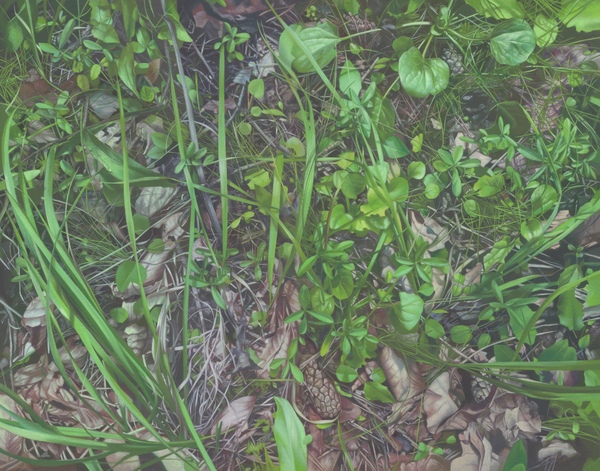
Poiesis (Woods) draws the viewer into a quiet clearing: soft earth, trampled leaves, and grass bent underfoot, illuminated by dappled light. At first glance, the painting appears devoid of figures—but the evidence of human presence is unmistakable. What we encounter is not a person, but their trace: the ground keeps track of footsteps, a subtle disturbance left by someone who passed through and is now gone. This idea—of the landscape as a silent witness—is central to Gabriele Grones’ Poiesis series. Rather than depict grand scenes or untouched wilderness, Grones focuses on modest, residual images: spaces where human presence meets the natural world in delicate, often unnoticed ways. The Greek term poiesis refers to the act of bringing something into being. In these paintings, the act of seeing becomes a kind of making— each work a distillation of time, movement, and memory. Poiesis (Woods) is not a romanticized forest, but a place touched by us—marked by the weight of a body, the trace of a gesture, the shadow of a pause. The finely controlled brushwork and muted palette reinforce the sense of intimacy and transience. What we see is not the figure itself, but its consequence: the trampled grass becomes a quiet index of experience. The origin of the work lies in a quiet moment: Grones' own passage through the woods, where his footsteps left only a subtle trace—a patch of flattened grass, barely visible yet unmistakably there. That impermanence held meaning. It was a fleeting encounter, made tangible through absence. Poiesis (Woods) becomes a visual meditation on that moment —on how we move through the world, and how the world, in its quiet way, remembers us.
Identification attributes
Physical attributes
Other artworks from this exhibitor
Gabriele Grones
Boccanera Gallery
Price by request
Diana Aparo
Boccanera Gallery
Price by request
Tura Oliveira
Boccanera Gallery
Price by request
Gabriele Grones
Boccanera Gallery
Price by request