Troika
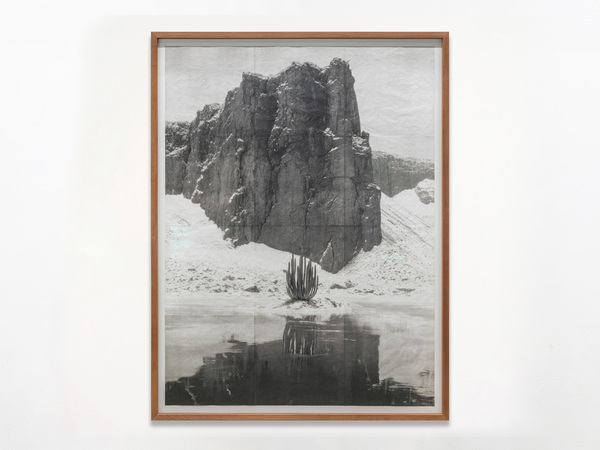
Out of Place Out of Time (Deception Island)
$45,000 USD
Artwork Description
There is a long human habit of making the land speak. We name coastlines Land’s End, rivers Lostman’s, volcanic harbours Deception Island, and a continent’s cold silence as the White South. These are not coordinates. They are stories, mythologies in reverse. They give the Earth personality, even agency — deceit, disappearance, finality. They anthropomorphise the world in our own image, mapping inner states onto outer terrain. But what if the land — or its flora — resists not through speech, but by staying, by adapting, by growing sideways, where it should not grow? Troika’s Out of Place, Out of Time is a study in this kind of resistance. These are landscapes that refuse to obey the rules of time or taxonomy. Their subjects — extinct plants, impossible ecologies, digitally imagined biomes — may appear fragile, but they persist with quiet defiance. Each image is created by an AI system trained on a visual archive of Earth, then printed in platinum and palladium salts, in a process designed to endure for a thousand years. But these are not photographs in the traditional sense — they are speculative reconstructions of what the planet might look like if memory were ecological, and history were porous. Each work in the series — Deception Island, Land’s End, Lostman’s River, White South — is titled after a real place, but none of them depict it directly. Instead, they conjure spaces that refuse singularity. Snow meets swamp. Palms grow from permafrost. Ancient English forests merge with the calving edge of the Halley Ice Shelf. These works collapse ecological certainties — but they do so not in despair, but in critique. In Land’s End, the Key Largo cactus stands on a British shoreline, an impossible migrant. It does not belong, but it grows. Its roots reach toward a ground that does not welcome it. This quiet persistence reframes the scene: the shore is not a line. It is not a neat edge, but a zone of exchange, instability, erosion, and renewal. In Troika’s landscapes, every place becomes a shoreline — permeable, transitional, resisting containment. White South merges the ancient Royal forest of Richmond Park with extinct tropical flora and an Antarctic field. Its trees — oak, yew, heather — coexist with the long-gone Rapa Nui palm and a cactus erased by rising seas. The composition holds these contradictions in tension, not to mourn them, but to keep them visible. In a time when climate crisis and digital abstraction often flatten the real, visibility itself becomes an act of resistance.
Identification attributes
Physical attributes
Exhibition history
Other artworks from this exhibitor
Candida Höfer
OMR
59.000 €
Sebastian Silva
OMR
$100,000 USD
Ana Montiel
OMR
$30,000 USD
Pia Camil
OMR
$25,000 USD